Patient falls were the most frequently reported sentinel event to The Joint Commission in 2024, accounting for 49% of voluntarily reported event. They also carry a real cost: longer stays, preventable injuries, and added strain on already-stretched nursing teams. For hospital leaders asking how to prevent falls in the hospital, the good news is that fall prevention isn’t a mystery – decades of clinical practice have identified what works, and a new generation of virtual care and AI technology is making it easier to act on that knowledge consistently, across every unit and every shift.
This guide walks through why falls happen, the evidence-based strategies that reduce them, how AI is extending, not replacing, the clinical team’s ability to catch risk early, and how fall prevention fits into the bigger picture of a hospital’s smart room strategy.
Why Patient Falls Occur in Hospitals
Patient falls in the hospital are rarely random. They tend to cluster around a predictable set of risk factors: impaired mobility or gait, medication effects such as sedation or sudden blood pressure changes, cognitive impairment or delirium, urinary urgency that prompts patients to get up without help, and simply being in an unfamiliar environment, often overnight, without a family member present. Add in IV poles, hospital gowns, and unfamiliar bathroom layouts, and the ordinary act of getting out of bed becomes a real risk.
An Evidence-Based Strategy to Prevent Falls
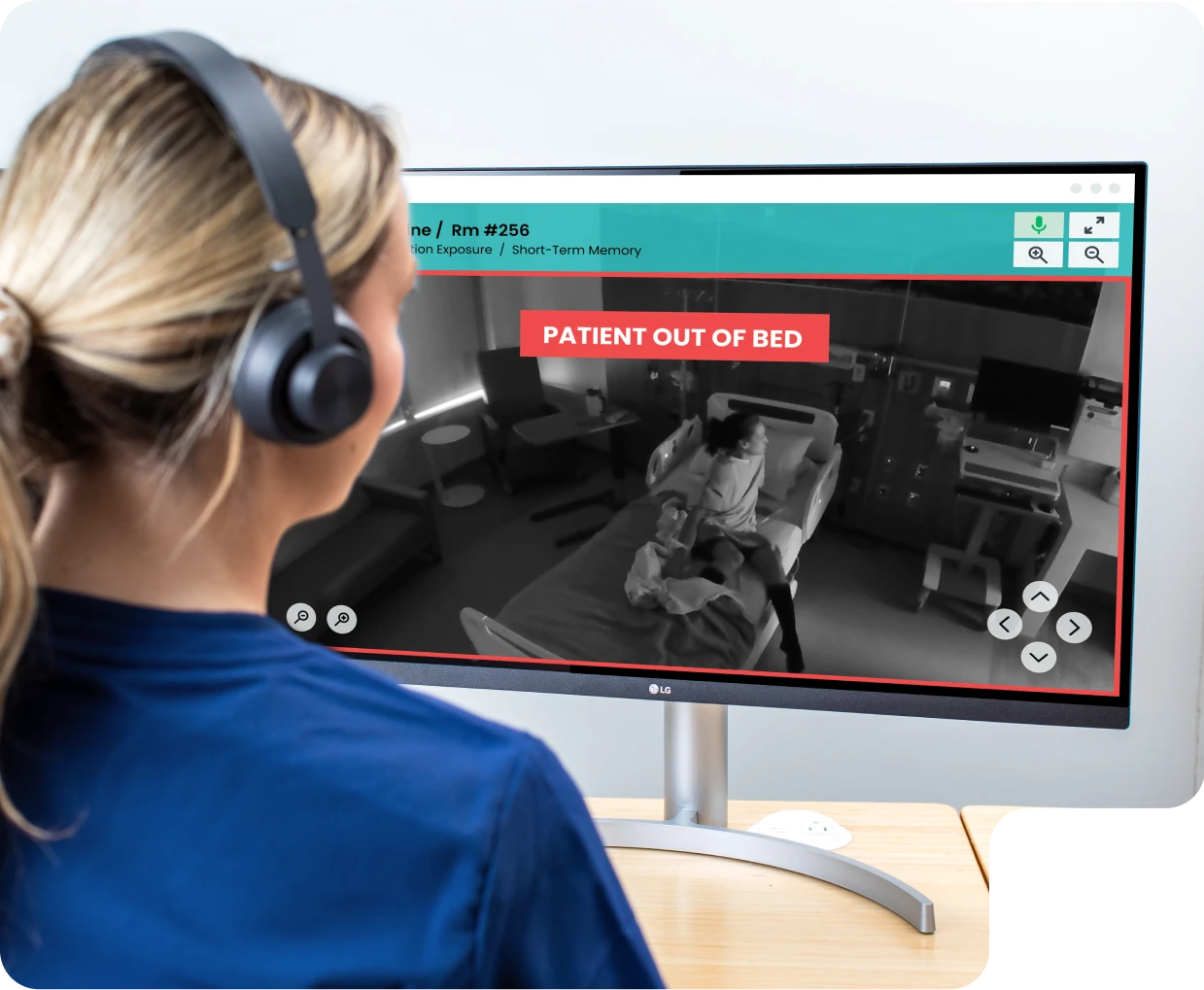
For patients who need more than periodic rounding, continuous observation (also called virtual sitting) adds a trained observer watching in real time. Instead of stationing a 1:1 sitter in every at-risk room, one observer covers many patients remotely. Hospitals can extend a limited nursing workforce without reducing the eyes on high-risk patients. A single Virtual Safety Attendant can safely observe up to 36 patients when supported by AI that helps detect potential adverse events before they occur. When a patient tries to get up unassisted, the AI alerts the attendant who can speak to them directly, alert bedside staff or trigger a stat alarm.
What Does a Virtual Sitter Do? The Role of the Virtual Safety Attendant
A virtual sitter, also called a virtual safety attendant (VSA), is the trained team member who monitors multiple at-risk patients from a central location instead of sitting in a single patient’s room for monitoring. In a virtual sitter hospital program, the VSA watches patients at risk of falls, and if a patient is getting out of bed or not following directions, the VSA can send an automated voice command, speak to the patient directly, or activate a stat alarm. The stat alarm is a loud, audible alarm in the patient’s room that tells bedside caregivers help is needed right away, and it can be routed through nurse call, mobile devices, or dome light systems.
Fall prevention is where virtual sitters can start, but not where their skills end: they are also trained to spot early behavioral cues, such as restlessness, repositioning, or reaching for side rails, and to step in verbally before a patient attempts to leave. The model also scales across a health system. At VA North Texas Health, a centralized monitoring hub lets four virtual safety attendants oversee 48 veterans, and the program has been paired with a nearly 20% drop in fall rates. At Gaylord Specialty Healthcare, a study comparing 20 months of baseline data with 20 months of virtual sitting found a statistically significant 90% decrease in 1:1 sitter hours and a 25% reduction in falls, allowing nursing staff to work at the top of their license instead of 1:1 sitting.
Several practices stand out in how leading hospitals set their virtual sitters up for success:
- Assess every patient individually. Care teams evaluate each patient to decide whether virtual sitting will meet their needs, and the conditions typically monitored include high fall risk, drug or alcohol withdrawal, confusion, agitation, low-to-moderate suicide risk, and elopement risk.
- Trial virtual sitting before defaulting to a one-to-one sitter. Upstate University Hospital required a mandatory two-hour trial of virtual sitting when a bedside RN was unsure how a patient would respond, and most trials let the patient stay with a virtual sitter. After the policy went hospital-wide, sitter usage dropped by an average of 7.1 full-time equivalents, an additional 33% decrease.
- Lead with verbal intervention. At St. Luke’s, virtual monitor staff hold more than 20 verbal interactions per patient per day, roughly twice the national average, and use stat alarms 0.2 to 0.5 times a day compared with an average of 2.0 at other organizations.
- Rotate roles to prevent monitoring fatigue. St. Luke’s pairs a monitor observer with a rounding specialist who also supports bedside staff, and the two switch places at least every four hours, depending on patient acuity.
- Keep the virtual and bedside teams in close communication. St. Luke’s nursing leaders named consistent, clear communication as one of three key elements behind the program’s success, and bedside staff there brought average alarm response time down to 9 seconds, compared with a 17-second national average in 2023.
- Hire and train for the role. Programs look for candidates with at least one year of healthcare experience who show accountability, empathy, courage, and reliability, then prepare them with education modules and competency checklists so they can confidently work on their own.
- Support and recognize the team. VA North Texas designated a nurse to handle administrative duties like clinical coordination, data review, and staff relief, which strengthened the partnership with nursing and raised the number of patients enrolled in the program. Recognizing virtual safety attendants through a “great catch” program reinforces their role as critical members of the care team.
Getting the VSA role right matters even more as AI-enabled technology enters the picture.
The Role of Technology in Fall Prevention
Remote continuous observation is a powerful tool to prevent adverse events, but it still relies on a human’s attention being in the right place at the right moment, across every monitor and every shift. That’s where AI-enabled technology is starting to add real value – not by replacing the observer, but by giving them an extra set of eyes that never gets tired or distracted.
The goal is not to replace human judgment. Instead, behavior-aware monitoring can recognize patterns associated with risk and surface them to caregivers in time to intervene. In practice, AvaSure’s computer vision models for falls and elopement are built to support the Virtual Safety Attendant, not replace them. The model surfaces a pattern, and a trained Virtual Safety Attendant decides what action to take. This human-in-the-loop design shows up elsewhere in the platform too: AvaSure uses AI-enabled sensing to monitor the observers themselves for signs of distraction or fatigue, with real-time alerts that help them re-engage before they miss something important.
The Falls and Elopement models employ a three-layer approach to perceive conditions within the hospital room.
- Lowest Layer: Detect whether there are people in the frame and estimate how many.
- Middle Layer: When there is a single person in view, form an understanding of posture and location relative to the bed and other furniture.
- Top Layer: Combine several seconds of posture data to recognize a meaningful pattern, such as a transition from lying to sitting to standing unassisted, rather than reacting to any single frame.
That sequence-aware approach exists because one video frame rarely tells the whole story: a patient sitting at the edge of the bed might simply be repositioning or might be about to stand and walk. Looking at the pattern of movement over time gives both the system, and the human reviewing it, far better context.
AvaSure also tunes the system’s sensitivity unit by unit. In safety-critical settings, the trade-off between catching every real risk (recall) and avoiding too many false alarms (precision) matters enormously. Too many false alerts and staff start to tune them out; too few, and real risk can slip through. AvaSure works with each hospital’s clinical and operational leaders to choose where a given unit should sit on that curve: a neurosurgical floor might tolerate more alerts in exchange for catching more events, while a lower-acuity unit may prioritize fewer interruptions. New hospitals also roll the system out gradually: it runs in the background first, without sending live alerts, so clinical teams can review how it performs in their own rooms before anyone relies on it day to day.
None of this replaces clinical judgment – it’s built to extend it. AI flags a pattern, and a trained Virtual Safety Assistant decides what happens next. For hospital leaders who are understandably cautious about introducing AI into patient care, that human-in-the-loop design is the detail worth paying the most attention to. For the full technical picture, including how AvaSure builds, tests, and continuously improves these models, see How AvaSure Builds AI for Patient Safety.
How Fall Prevention Fits Into a Smart Room Strategy
Fall prevention rarely exists in isolation, and it’s usually one of the problems a hospital names when it starts building a broader smart room strategy. AvaSure defines a smart room as a connected care environment where technology, workflows, and intelligence work together to support patients, caregivers, and hospital operations. For many health systems, the most pressing gap might be falls and pressure injuries on high-risk units, or the cost of 1:1 sitters.
The key difference is point solution versus platform. Using remote continuous observation to watch for falls is a single use case that solves only one problem. AvaSure’s virtual care platform is the eyes and ears of the smart room: the same camera and microphone already at the bedside power fall and elopement detection, virtual nursing, ambient listening and other AI-enabled applications. Its open architecture connects the EHR, devices and AI partners, so every new partner or use case makes the room smarter without adding hardware or another vendor relationship.
That matters financially, too. Virtual care programs built on AvaSure’s platform have achieved:
- 65% reduction in RN traveler hours
- 26% reduction in RN overtime
- 11.6% reduction in length of stay
- 34 fewer readmissions tracked year-over-year on the same unit
Virtual sitting alone has replaced an average of 70% of 1:1 sitter spend, with those savings helping fund the rest of the smart room program.
For a hospital leader evaluating fall prevention technology, the question isn’t only “does this reduce falls?” It’s also “is this a solution that can be built on?” A fall prevention tool that can’t later support virtual nursing or ambient listening creates a decision the hospital may have to make again in two years.
How AvaSure Supports Hospital Fall Prevention
AvaSure supports fall prevention through the AvaSure Continuous Observation solution. Trained Virtual Safety Attendants observe patients remotely, with AI-enabled computer vision that helps them catch risk earlier and stay focused across every room they cover. The solution runs on the virtual care platform trusted by 1,200+ hospital partners, so a hospital that starts with fall prevention can add virtual nursing, virtual visits and other smart room capabilities later on.
Hospitals don’t have to choose between staffing coverage and technology. A single Virtual Safety Attendant can observe up to 36 patients when AI-enabled fall and elopement detection flags early warning signs, like a patient shifting from lying down to sitting at the edge of the bed, in time for the attendant to intervene. AvaSure’s Chief Clinical Officer, Lisbeth Votruba, is a co-investigator in an IRB-approved, multi-site study of observer-to-patient ratios in AI-assisted virtual sitting. The goal is to give hospitals real data on what ratios keep patients safe.
For hospitals deciding where to start, AvaSure recommends anchoring the decision in outcomes, not technology alone, and involving clinical teams from day one.
Key Takeaways
- Patient falls cluster around a predictable set of risk factors (mobility, medication, cognition) and predictable moments (overnight, during transfers, after medication changes).
- The most effective fall prevention programs combine risk screening, proactive rounding, medication review, and continuous observation for higher-risk patients.
- AI-enabled computer vision extends, not replaces, a Virtual Safety Attendant – surfacing early movement patterns while a trained person still makes the call on intervention.
- Fall prevention technology delivers more value as part of an open smart room platform rather than a single-purpose point solution, since the same cameras and infrastructure can support virtual nursing and other AI-enabled use cases later.
- Programs built on this kind of platform have shown measurable results: reduced RN overtime and traveler hours, shorter length of stay, fewer readmissions, and significant offsets to 1:1 sitter costs.
Next Step
Fall prevention is where a smart room strategy can start, but it shouldn’t be where it ends. For a practical framework on how to build that strategy, download the whitepaper, 5 Lessons for Defining and Executing a Smart Room Strategy.
Fall Prevention & Virtual Sitter FAQ
Hospitals prevent falls by combining clinical protocols with technology that helps staff act on risk consistently, across every shift. For patients who need more than periodic rounding, continuous observation adds a trained virtual safety attendant watching in real time, with AI-enabled technology helping that attendant catch risk earlier.
Continuous observation, also called virtual sitting, uses a remote Virtual Safety Attendant to monitor multiple patients over live video rather than stationing one staff member outside a single patient’s room. This category traces back to the TeleSitter® solution launched in 2009 and has since evolved into today’s AI-enabled Continuous Observation solution, where a single attendant can monitor up to 36 patients at once – replacing an average of 70% of 1:1 sitter spend.
A virtual sitter, also called a Virtual Safety Attendant, monitors multiple at-risk patients from a central location instead of sitting in a single patient’s room. If a patient is getting out of bed or not following instructions, the virtual sitter can send an automated voice command, speak to the patient directly, or activate a stat alarm that alerts bedside caregivers that help is needed right away.
Strong programs assess each patient individually to decide whether virtual sitting is a fit. They also train virtual sitters to lead with verbal intervention, rotate observers at least every four hours, depending on patient acuity, to prevent monitor fatigue, and keep the virtual and bedside teams in close, consistent communication.
AI-enabled computer vision watches for the behavior patterns that typically precede a fall – for example, a patient moving from lying down to sitting at the edge of the bed – and surfaces that pattern to a human observer in time to intervene. The goal is not to replace human judgment, but to build behavior-aware monitoring that recognizes risk patterns and surfaces them to caregivers.
No. The model surfaces a pattern, and a trained Virtual Safety Attendant still decides what action to take. The same human-in-the-loop principle applies to the observers themselves: AI-enabled sensing monitors them for fatigue or distraction and prompts them to re-engage before they miss something important.
Computer vision can’t predict the future, but it can recognize the sequence of behavior that typically precedes a fall and alert a human observer early enough to intervene. These models reason over several seconds of movement rather than a single video frame, distinguishing routine repositioning from a patient about to get up unassisted.
Falls and pressure injuries on high-risk units are among the most common starting points when health systems define a smart room strategy. Because fall prevention cameras and microphones can also power virtual nursing, ambient listening, and other AI-enabled applications on the same open platform, fall prevention becomes a first use case rather than a standalone purchase.
Results vary by hospital and unit, but programs built on this kind of platform have shown a 65% reduction in RN traveler hours, a 26% reduction in RN overtime, an 11.6% reduction in length of stay, and 34 fewer readmissions tracked year-over-year on the same unit.
Ready to get started?
Get in touch with an AvaSure representative to learn more about AvaSure's AI-enabled virtual care solutions.