What is a Smart Room?
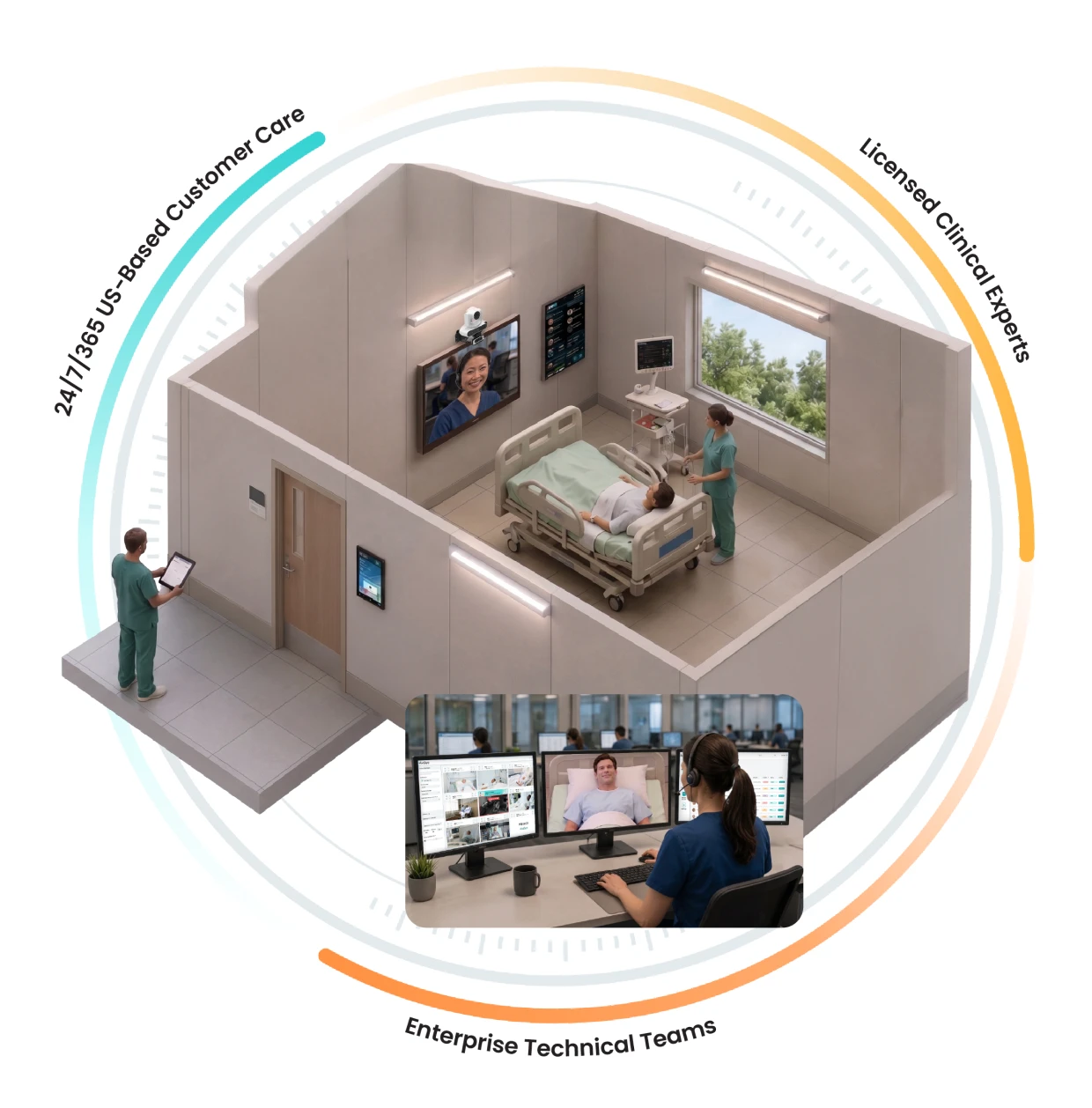
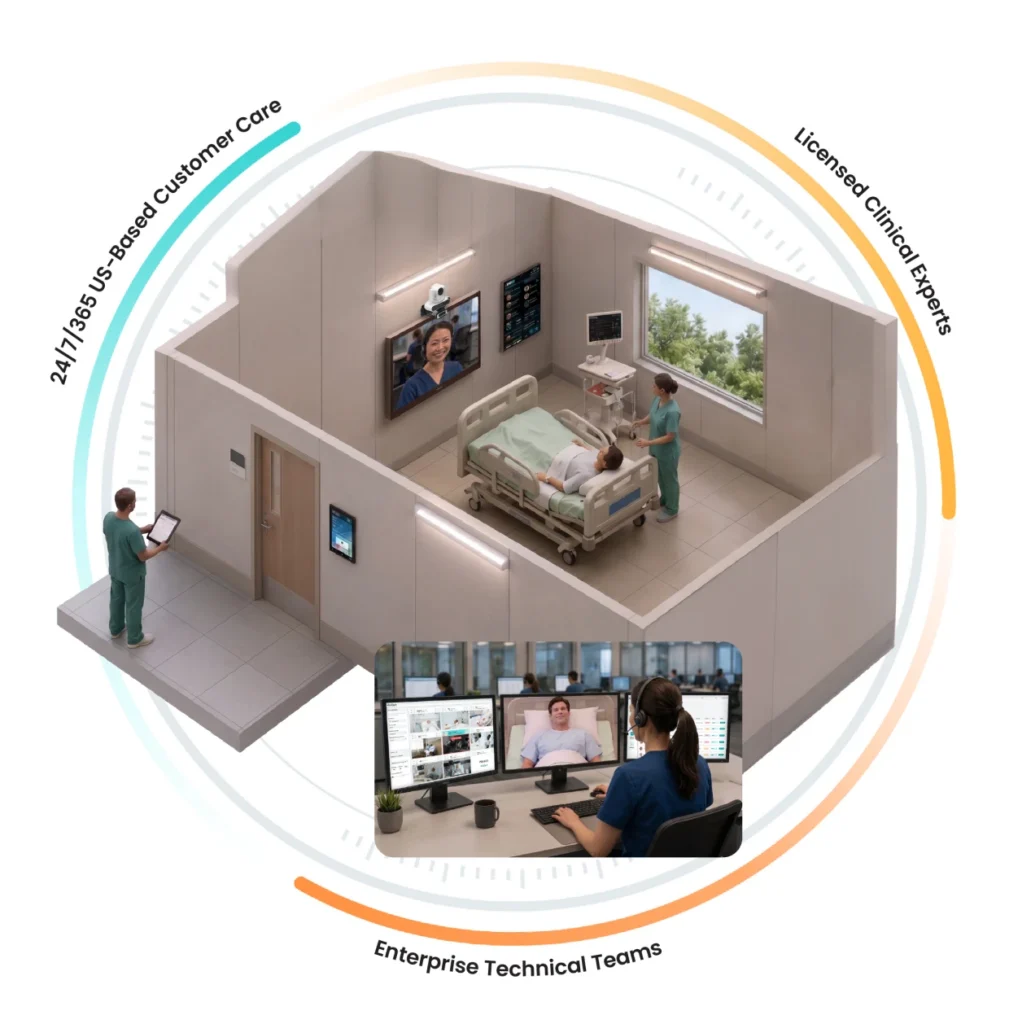
A smart room is a connected care environment where technology, workflows, and AI work together to support patients, caregivers, and hospital operations. It combines virtual care, ambient listening, computer vision, digital whiteboards, patient engagement, and digital door signs, all connected to the systems hospitals already rely on: the EHR, nurse call, translation services, and clinical peripherals.
Building a smart room starts with a strategy
The first step in building a smart room is defining the strategy behind it. No two smart rooms look the same, because each health system should build its strategy around its own gaps and priorities. For one hospital, the most pressing gap might be falls and pressure injuries on high-risk units, or the cost of 1:1 sitters. For another, it might be nurses losing hours to admission and discharge documentation, or patients who feel left in the dark between rounds. Priorities vary too, from easing the workload on a short-staffed nursing team to improving patient experience scores, reducing length of stay or preparing to adopt AI tools as they mature. Clinical teams know those gaps best, so they should help shape the strategy from the start rather than react to a finished design.
Still, every smart room strategy depends on the same foundation: a virtual care platform that connects it all in one place, rather than juggling disconnected point solutions. This is because a smart room isn’t defined by any single device or application. It’s defined by how technologies work together to improve care delivery. Get the strategy and the platform right, and the smart room can grow with the health system instead of being rebuilt every time its needs change.
“A smart room, to me, is where technology is intentionally integrated to extend the capabilities of the care team… with the intention of coming together to create a cohesiveness and an ease of flow, so that clinicians can take care of patients in the best way possible, removing friction from care delivery, to the point that the technology fades into the background.”
Dr. Stephanie Lahr, Founder, Vital Thread Advisory, in the ATA webinar From Smart Rooms to Smart Flow
Key Takeaways
- A smart room is a strategy, not a device checklist. It should be anchored to outcomes like access, workforce optimization, quality and experience.
- Clinical teams should help shape the smart room strategy from the start, not react to a finished design.
- The core of a smart room is the virtual care platform that powers it – connecting care teams, clinical workflows, AI-enabled applications, and hospital systems into one seamless experience.
- Having an open architecture virtual care platform allows health systems to add new capabilities over time without rebuilding workflows and integrations.
For a step-by-step approach on how to shape your strategy, download the whitepaper, 5 Lessons for Defining and Executing a Smart Room Strategy.
Why are smart rooms important now?
Walk into most hospital rooms today and you’ll find more technology than ever: a TV, a whiteboard, a nurse call system, a camera, maybe a tablet or two. What you often won’t find is that technology working together.
That’s the problem smart rooms are meant to solve. Instead of adding one standalone tool after another, health systems are working toward a more coordinated environment. In that kind of room, technology is connected to the workflows and systems that support care, patients stay informed, and care teams have more ways to reach them.
The timing reflects real pressure. Health systems face nursing shortages, rising patient acuity, rising costs and growing demand for access. Asking more of stretched care teams isn’t the answer. Extending their reach is.
The technology meant to help has often added complexity instead. The patient room is crowded with point solutions, and each one brings its own device, integration, support contract and training burden.
Meanwhile, AI is moving fast. Ambient listening, computer vision and contactless monitoring show real promise for patient safety and caregiver workload. But most hospitals don’t yet have the foundation to use these tools at scale, connected to the EHR and built into the workflows clinicians already use.
Leaders feel the tension between building for the future and getting through today. As one system chief nurse told AvaSure Chief Clinical Officer Lisbeth Votruba: “Smart hospital investment is the most important thing we need to do for our future. But we have to survive today.” A well-designed smart room strategy addresses both.
What technology is in a smart room?
Every smart room is configured to the health system’s goals, but many share the same building blocks. At the center is a virtual care platform that provides the audio and video these components rely on.
| Component | What it does in the room |
| Virtual care platform | The foundation. Connects care teams, clinical workflows, devices, and AI-enabled applications in one system. |
| Virtual care services | Virtual nursing, virtual visits, and continuous observation, delivered over two-way video and audio. |
| Computer vision | Use the in-room virtual care device to see and understand what’s happening when staff aren’t in the room – supporting fall, elopement and pressure injury prevention. |
| Ambient listening | Captures conversations through the in-room virtual care platform so clinicians can care hands-free and spend less time documenting. |
| EHR integration | Brings labs, history and imaging into the room and keeps virtual care inside existing workflows. |
| Room displays | The in-room TV, digital whiteboards and door signs share real-time information with patients, families, and staff. |
| Connected systems | Nurse call, translation services, patient monitoring devices, and other clinical peripherals. |
Without a shared platform, these components become another set of point solutions. With one, care teams and patients are given a consistent presence at the bedside, even when no one is physically there.
“The smart hospital isn’t defined by one application or one device. It’s defined on how the technology in the room works together in a single platform, so that every time one of those innovates, the room gets smarter… the room becomes an active participant in patients’ care. And we can have safer care, giving caregivers support and health systems the intelligence that they need.”
Lisbeth Votruba, MSN, RN, Chief Clinical Officer, AvaSure, in the ATA webinar From Smart Rooms to Smart Flow
How can a smart room evolve over time?
Point solutions address a specific need, often on one unit. A smart room platform gives health systems a foundation to support more use cases across care units and care settings and add capabilities as priorities change.
| Point solutions | Smart room platform | |
| Scope | One use case, often one unit | Multiple use cases, across units and care settings |
| Hardware | A new device per application | Shared devices and infrastructure |
| Integration | Rebuilt for each vendor | Built once, reused by every new capability |
| Clinician experience | Multiple logins, workflows and trainings | One experience inside existing workflows |
| Future innovation | Limited to one vendor’s roadmap | New AI partners plug into the same foundation |
An open architecture means the platform is built to connect with other vendors’ technology, not just its own. Its audio and video infrastructure is available to outside applications through open APIs, and it integrates with the systems hospitals already rely on, like the EHR and nurse call. A computer vision tool, an ambient listening solution or a new AI application from a third-party partner can use the cameras and microphones already in the room, without adding another device. That gives health systems room to choose the technologies that fit their needs and add them over time, so the room can grow without starting from scratch.
“I think of smart room software in particular as a chassis whereby you can plug in the tools that you need at any point without altering the foundation you have built, the integrations you have gained, and the patient and provider experience.”
Emily Warr, MUSC Center for Telehealth, in the HIMSS webinar A Clinical Leader’s Guide to Defining and Executing a Smart Room Strategy
Interoperability also protects patients. As Warr notes, handoffs are where most mistakes happen, and that is as true for disconnected technology as it is for shift change.
What results do smart rooms deliver?
Smart rooms improve patient safety, give care teams back time and produce outcomes finance leaders can measure.
Safer care with the same workforce. Harris Health partnered with AvaSure for virtual sitting to protect patient safety despite resource constraints.
“We’re not replacing any of our bedside personnel, we’re just taking some of that burden off of expecting them to be all-knowing, all-seeing… I think our nurses have really enjoyed having that piece… They’ve got that extra set of eyes supporting them, and if that observer is recognizing something, like the patient’s beginning to get out of bed, there’s an early intervention, and so we can start to move those pieces more quickly than if that responsibility had been solely on the bedside nurse.”
Leslie Ferrell, MHA, Administrative Director of Virtual Care, Harris Health, in the ATA webinar From Smart Rooms to Smart Flow
Better access and fewer readmissions. At Jersey Shore University Medical Center, hospitalists use AvaSure to reach patients in their rooms on demand.
“We have had the pleasure of working with AvaSure, which lets us be in patients’ rooms on demand when they have questions or need follow-ups… I believe that it not only improves the patient experience and the value we provide, but also prevents readmissions.”
Dr. Mohamed Bakr, VP, Hospital Medicine, Hackensack Meridian Health, in the ATA webinar From Smart Rooms to Smart Flow
Measurable financial results. Virtual care programs built with AvaSure have achieved a 65% reduction in RN traveler hours, a 26% reduction in RN overtime, an 11.6% reduction in length of stay and 34 fewer readmissions, tracked year-over-year on the same unit. Virtual sitting replaces an average of 70% of 1:1 sitter spend, and those savings can help fund the rest of the program.
Financial return isn’t the only measure. Ferrell’s team also tracks observation hours, safety events, escalation time, nursing time and discharge timing.
“Sometimes we get so focused on what is that financial return, that we forget to pay attention to workforce capacity, patient safety, throughput, access to expertise, staff experience, and patient experience. All of those things matter.”
Leslie Ferrell, MHA, Administrative Director of Virtual Care, Harris Health, in the ATA webinar From Smart Rooms to Smart Flow
How do you build a smart room strategy?
Start with the problem, not the technology. In a HIMSS webinar hosted by AvaSure, Emily Warr of the MUSC Center for Telehealth and AvaSure Principal Product Manager Brad Smith outlined how health systems can get it right. Their guidance comes down to five lessons:
- Define the strategy before the technology.
- Design for openness and configurability.
- Bring clinical teams in early.
- Win buy-in by connecting services to outcomes.
- Let your primary objective determine who leads.
“It’s not about the setup in the room, it’s about the service. It’s about solving the problems, it’s about aligning with the strategic priorities of the organization. Once you have those elements in place, that’s when you can choose the technology.”
Emily Warr, MUSC Center for Telehealth, in the HIMSS webinar A Clinical Leader’s Guide to Defining and Executing a Smart Room Strategy
The operating model matters as much as the technology. As Leslie Ferrell of Harris Health put it, deployments that struggle usually do so because teams “underestimated the operating model that we needed to have around it,” not because the technology failed.
That’s why the right partner matters. Look for experience with complex, multi-department implementations, deep clinical expertise to drive change management and adoption, and a customer success team that stays with you long after go-live.
Go deeper: Download the whitepaper: 5 Lessons for Defining and Executing a Smart Room Strategy
Build your smart room strategy with AvaSure
The smart room era is here, and the health systems that start building now will be best positioned for what comes next. AvaSure brings 15+ years of clinical expertise in virtual care, 1,200+ hospital customers and an open platform that connects your EHR, devices, and AI partners. Our clinical team works alongside your nurses and leaders before, during, and long after go-live.
Whether you’re starting your smart room journey or resetting it, we’ll help you map the strategy to the outcomes that matter most.
- Get the playbook: Download 5 Lessons for Defining and Executing a Smart Room Strategy
- Talk to our team: Start building your smart room strategy
Smart Room FAQ
A smart hospital room is a patient room where virtual care, AI-enabled tools, displays and clinical systems work together on one platform to support patients, caregivers, and hospital operations.
A smart room is the connected patient room. A smart hospital extends that approach across the facility, using connected rooms to improve patient flow and relieve bottlenecks in the ICU, floors and emergency department.
Every smart room is configured to the health system’s goals, but many share the same building blocks. Most include a virtual care platform that provides two-way video and audio, computer vision, ambient listening, EHR integration, in-room displays such as TVs and digital whiteboards, and connections to nurse call, translation services, and clinical devices.
No. A smart room extends the reach of care teams. Virtual observers and virtual nurses take on tasks that don’t require hands at the bedside so clinicians can practice at the top of their license.
Open architecture lets health systems add new AI partners and capabilities without replacing devices, rebuilding integrations or retraining staff. Each new partner makes the room smarter.
Start with one unit and one problem tied to a strategic objective, such as patient safety, access, or workforce. Bring clinicians in early, then choose technology that fits the strategy.
AvaSure is the virtual care platform powering the smart room. It provides the eyes and ears in every patient room and connects care teams, clinical workflows, the EHR, devices, and AI-enabled applications on one platform.
Ready to get started?
Get in touch with an AvaSure representative to learn more about AvaSure's AI-enabled virtual care solutions.