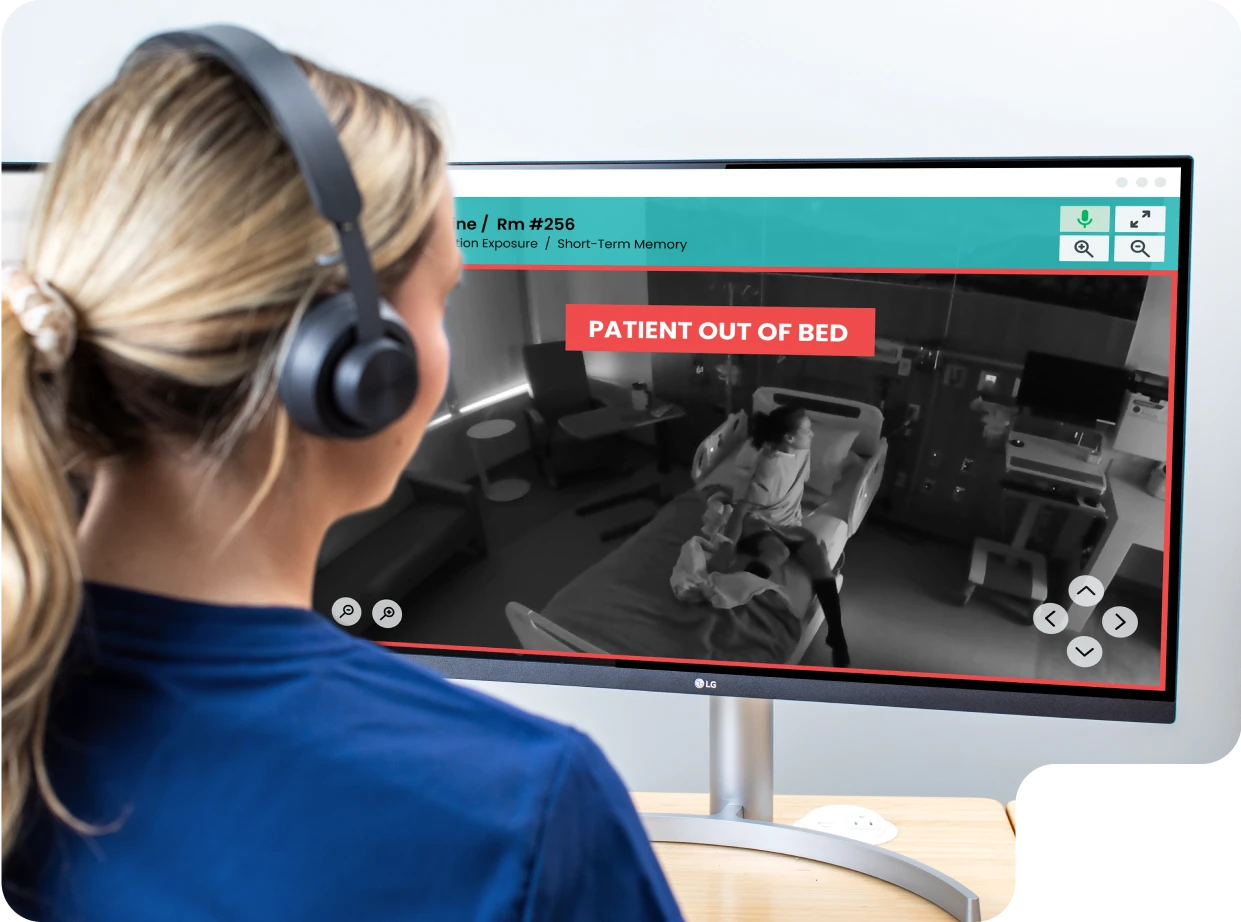
From Sitters to Strategy: How Virtual Sitting Delivered $3.2M in Measurable Impact
ROI, Virtual Sitting
February 18, 2026
Kalafas, L. et al, (2025) Implementation of a continuous video monitoring to decrease inpatient falls in a long term acute care hospital setting: a prospective observational cohort study. Published in the American Journal of Nursing (AJN) 125(12):20-27.
Driving Measurable Quality and Financial Outcomes with Virtual Sitting
This newly published peer-reviewed study provides one of the most rigorous evaluations to date of a continuous virtual video monitoring program in a long-term acute care hospital (LTACH) setting — demonstrating sustained improvements in both patient safety and financial performance over 40 months.
Key Results
25% reduction in patient falls
- Statistically significant decrease in falls (p = 0.02)
90% reduction in 1:1 sitter hours
- Highly significant reduction in sitter utilization (p < 0.001)
$3.2M in total cost savings
- $160,234 ROI from sitter cost reductions
- $3,041,390 in avoided fall-related costs
- Based on updated cost-of-falls estimates from Dykes et al. ($35,365 per fall)
Challenge
Hospitals continue to search for scalable ways to reduce patient falls while controlling the high costs associated with one-to-one sitters. While virtual sitting has shown promise in acute care settings, there has been limited long-term, peer-reviewed evidence demonstrating both quality and financial outcomes—particularly in long-term acute care hospitals (LTACHs).
This organization sought to answer critical questions:
- Can a virtual sitter program meaningfully reduce falls over time?
- Can it significantly decrease reliance on costly 1:1 sitters?
- What are the true financial returns when outcomes are measured transparently?
Study Design & Setting
- 137-bed long-term acute care hospital (LTACH)
- 20 months of baseline data
- 20 months of intervention data
- Published in the American Journal of Nursing (AJN), the oldest and largest circulating, broad-based nursing journal globally
The extended patient length of stay in the LTACH setting allowed virtual sitters to develop deeper familiarity with patient behaviors, enabling more proactive and effective monitoring strategies.
Financial Analysis
The organization took a transparent, conservative approach to financial modeling:
- Sitter cost savings were calculated directly from reduced 1:1 sitter hours
- Fall-related cost avoidance used contemporary, peer-reviewed cost benchmarks
Together, these outcomes generated $3.2M in measurable financial impact.
Best Practices & Operational Insights
The study provides actionable insights into how these outcomes were achieved—not just the results themselves.
Intentional Resource Management
- Virtual sitters were actively assigned, reassigned, and discontinued based on patient need
- The program avoided “set it and forget it” monitoring
Optimized Sitter-to-Patient Ratios
- Ratio increased from 1:10 in the first 9 months
- Expanded to 1:12 in the final 11 months of the study
As the ratio increased:
- One-to-one sitter hours continued to decline
- Fall rates continued to decrease
This demonstrated that the higher ratio delivered superior quality and financial outcomes, challenging assumptions that lower ratios are always safer or more effective.
Summary
This pioneering LTACH study reinforces what earlier acute care research has shown: when virtual sitting is deployed thoughtfully and managed intentionally, it can deliver meaningful improvements in patient safety while generating substantial cost savings.
By pairing long-term data, transparent financial analysis, and operational discipline, this organization demonstrated how virtual sitting can evolve from a staffing alternative into a strategic, high-value care model.